
What About Greenland?
The case for the U.S. acquiring the island...
Steven A. Carlson
7 min read
Reconciling Immigration and the U/S. Constitution - Part 1
Reconciling Immigration and the U/S. Constitution - Part 2


To see a list of all commentaries, click the above picture.
Proof of Citizenship and the American Voter
Yes, Congress Can Write Election Laws



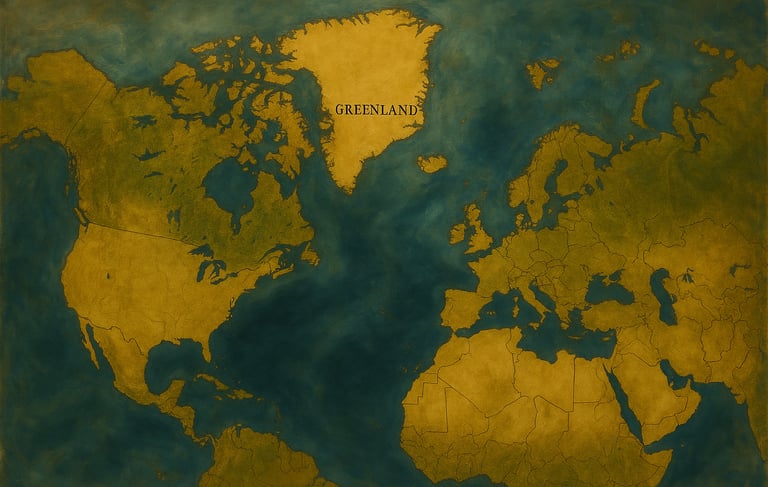
Historical Context and Strategic Importance
Greenland, the world's largest island (roughly three times the size of Texas), has a storied history marked primarily by its colonial ties with the country of Denmark, which began colonizing the island in the early 18th century. (Flat maps tend to distort the size of the island due to the curvature of the earth). Over the course of time, Greenland has been deeply integrated into the Kingdom of Denmark. However, of late the island’s residents have developed a considerable degree of self-governance. This began in 1979 with the Home Rule Act through which the people of the island proclaimed themselves to be autonomous where domestic affairs were concerned (education, etc.) while Denmark retained control over matters like defense and natural resource exploration. The Self-Government Act of 2009 further strengthened that autonomy. Still, Denmark maintains control over foreign affairs, a fact that has spurred ongoing debates about Greenland’s future, especially given the United States’ interest in acquiring the island.
Greenland occupies a strategic geographical location in the North Atlantic where it serves as a natural bridge between North America and Europe. This location has heightened its importance in the geo-political arena, particularly where national security is concerned. The island is uniquely positioned, providing invaluable proximity to shipping routes. The land also holds vast natural resources including minerals and an emerging potential for oil and gas exploration, This explains why nations, including the U.S., view Greenland not as a mere landmass, but as an extremely valuable asset worth developing.
The strategic importance of Greenland is especially significant when it comes to military logistics. The establishment of strong military bases on the island could provide a significant advantage when it comes to facilitating operations across the Arctic. For the U.S., it would offer an advantage when it comes to offsetting Russian influence in the region and an improved safety net for early missile detection. It is easy to see why access to Greenland is becoming increasingly crucial for navigation and resource extraction.
The proposed U.S. acquisition of Greenland would provide for the expansion of U.S. influence in the Arctic, bolstering national defense strategies and enhancing energy security. As the nations of the world have begun to demonstrate interest in the rapidly changing Arctic, the question of sovereignty over Greenland presents urgent national and international considerations. Thus, understanding Greenland's historical context and its strategic geographical location is critical when considering the case for American acquisition of the island.
Some U. S. citizens, looking through a strictly political lens, seem troubled over the notion that this nation might simply take over someone else’s land, particularly if that happened through the use of force. Suffice it to say that there is no plan to take the island by force. What many don’t realize is that U. S. interest in acquiring Greenland is not a new idea that originated with Donald Trump. Since the late 1800’s many presidents, both Democrat and Republican, have seriously eyed the possibility.
In 1867, during negotiations over the purchase of Alaska and with Andrew Johnson as president, Secretary of State William H. Seward outlined the advantages of acquiring the island. Comparable discussions took place in 1910 with Taft, a Republican, as president. However, the first official, although secretive, offer was made in 1946 when Truman, a Democrat, held the office. Other offers were drafted in the 1950’s with Eisenhower, a Republican, serving as president. After that, the idea was dropped, for the most part, until Trump was elected. Consequently, for those who are distressed over the idea of the U.S. acquiring Greenland because Trump is involved, that concern is misplaced. After all, if growth through the acquisition of land was un-American, then locations like Alaska, Florida, Louisiana and others would not be part of the U. S.
Economic Opportunities and Natural Resources
Greenland is known to possess large reserves of rare minerals. This includes substantial rare earth elements that are crucial for certain high-tech industries like electronics. The acquisition of Greenland by the United States could unlock substantial economic opportunities given this wealth of natural resources. These resources are increasingly in demand, and their procurement could significantly bolster the U.S. economy.
As mentioned earlier, in addition to being rich in minerals, Greenland holds significant oil and gas reserves that could prove to be most valuable. Tapping into these energy resources could play a central role in helping the United States achieve longed-for energy independence. By reducing reliance on foreign oil, the U.S. could enhance its national security. The acquisition would also undoubtedly boost the U.S. economy by creating numerous jobs in the extraction, transportation, and refining sectors. If the resources are as vast as anticipated, their development would not only contribute to local employment on the island, but could also stimulate broader economic growth across multiple industries both on the island and across the mainland of America.
Therefore, the combination of abundant natural resources, the potential for job creation, and enhanced strategic trade routes illustrates the economic rationale behind the consideration of Greenland's acquisition by the United States. These factors collectively suggest that such a strategic move could yield significant long-term benefits for the nation's economy.
Partnering with Greenland’s Residents
The U.S. would naturally be expected to prioritize stewardship of the natural resources in Greenland, which include its unique biodiversity, icebergs, and oceanic systems. Additionally, since the Arctic is becoming increasingly strategic where international politics and natural resources are concerned, the U.S. is much better positioned to develop a system of sustainable resource practices. Indeed, the U.S. could implement policies that help draw a balance between economic growth and environmental protection.
The U.S. should, of course, take full advantage of the Indigenous Greenlandic populations and their wealth of knowledge where the local ecosystems are concerned. Partnering with these communities, the U.S. could respect traditional practices and cultural heritage. This approach would go a long way in fostering support and respect from Greenland residents by recognizing their innate value to the U.S. through local community involvement.
Geopolitical Dynamics and International Relations
Should the U. S. acquire Greenland, it would have profound implications for the geopolitical landscape of the Arctic region and beyond. Given its untapped natural resources, strategic maritime routes, and tactical military opportunities, interest by global powers in the Artic region (especially Russia and China), has significantly increased recently. By securing Greenland, the U.S. could enhance its influence over the increasingly contested Arctic territories, creating a buffer against Russian expansionism and asserting its leadership in global governance related to Arctic policy.
As it stands now, Greenland is a seemingly helpless island waiting for takeover by a superior force. Should China or Russia move to take the island, it would not be by negotiation, but by force. Denmark is incapable of providing the protection necessary to safeguard the island from such a takeover. Consequently, without U. S. support, Greenland could land in the hands of a totalitarian regime. It is safe to say that the residents of Greenland would fare much better if aligned with the United States.
China has been actively pursuing its interests in the Arctic through research initiatives and investments, attempting to establish a presence in this crucial region. Specifically, China has been developing sea routes through the Arctic to provide quicker access to European ports since Egypt has become difficult when it comes to China’s use of the Suez Canal. The U.S. acquisition of Greenland could curtail China’s ambitions in the region, creating a more favorable balance of power. Such a shift could lead to increased competition and necessitate new strategies for cooperation or conflict resolution among these global players.
While U.S. acquisition of the island makes sense for the U.S., Greenland, and Denmark, it is vital to ensure stability of international relations. Denmark plays a critical role in discussions regarding Greenland's future, and The U.S. must wisely navigate that relationship. The acquisition of Greenland must also align with diplomatic protocols and cannot undermine the strength of current relationships with other nations inside NATO, although this organization is probably less of a concern since its relevance has weakened in recent years.
It is important to maintain U.S.-Danish relations by providing a smooth transition beneficial to both parties rather than the U.S. forcing Denmark into a deal based on U.S. superiority. One fair deal might be for the United States to accept the island in exchange for the nearly $150 billion debt Denmark owes the United States. This is the kind of arrangement that will likely take place, allowing Denmark to hold its head high and other nations to respect the arms-length character of the agreement.


Navigating the Second Amendment


Birthright Citizenship - Digging into the Fourteenth Amendment






Reconciling Immigration and the U/S. Constitution
Policy v Politics
Socialism v Fascism



Free Speech - Rights and Responsibilities
Reconciling Immigration and the U.S. Constitution - Part 2
Reconciling Immigration and the U.S. Constitution - Part 1

See below for contact information


This book will truly enhance your understanding of the Declaration of Independence and the United States Constitution. Click the button below to check it out.
___________________________________________________________________________________________________________________________________________________________________________________________________


Contact
Questions? Reach out anytime.
Email:
contact@constitutionmatters.net
© 2025. All rights reserved.