
Socialism v Fascism
Understanding and Dissecting Socio-Fascist Ideology
Steven A. Carlson
5 min read
Political Verbiage
When discussing political ideologies, several terms tend to find their way into the narrative. Words like collectivism, socialism, nationalism, and fascism have become household words of late. On the surface, collectivism and socialism seem to blend together quite well. In fact, purportedly, the focus of socialism is on collectivism. The idealistic claim of socialism is that everyone should benefit equally from the assets of the collective.
While collectivism and socialism are closely allied, the same is not particularly true of nationalism and fascism, despite the claims made by many in the political arena. According to Brittanica.com, nationalism is an "ideology based on the premise that the individual’s loyalty and devotion to the nation-state surpass other individual or group interests...." However, that definition overstates the idea of loyalty and devotion since it suggests that a nationalist emphasizes devotion only to his/her nation with no concern for the interest of other individuals or groups. In fact, an individual who is loyal to his/her homeland may well be a member of another group or groups whose interests would warrant consideration. Therefore, unlike collectivism and socialism, nationalism and fascism are not the kindred spirits depicted by those on the left side of the political aisle. Nationalism is loyalty and devotion in the sense that you seek the best possible outcome for your nation given the circumstances and the available opportunities. It seems reasonable to suggest that this should be the objective of every nation on earth.
Fascism, on the other hand, depends on a strictly hierarchal form of governance and what might be called hyper nationalism where the emphasis really is on devotion only to nation and nationality (built on the notion of racial superiority) with no concern for the interests of other individuals or groups.
The Principles of Socialism
Socialism is presumably built on the idea of collective ownership and governmental control of the societal means of production. It emphasizes the need to address social inequalities and promote welfare for all citizens. Unlike capitalism, where the focus is on individualism (rights and ownership), socialism claims to prioritize the well-being of the collective (community) and ensure that resources are distributed fairly. This focus on shared resources and collective responsibility is often championed as an antidote to what socialists view as the individual excesses of capitalist societies. This is, at least, the language of Socialism.
The Nature of Fascism
Fascism is an authoritarian ideology that claims to reject the core tenets of socialism. Fascists advocate for a strong, centralized government led by a dictatorial figure, where individual rights are often sacrificed for the good of the state. Fascism typically promotes hyper nationalism, militarism, and the supremacy of one group over others, often demonizing minorities or opposing ideologies. This is distinct from the equitable inclusivity that is said to be the goal of a socialist society.
Key Differences and Overlaps
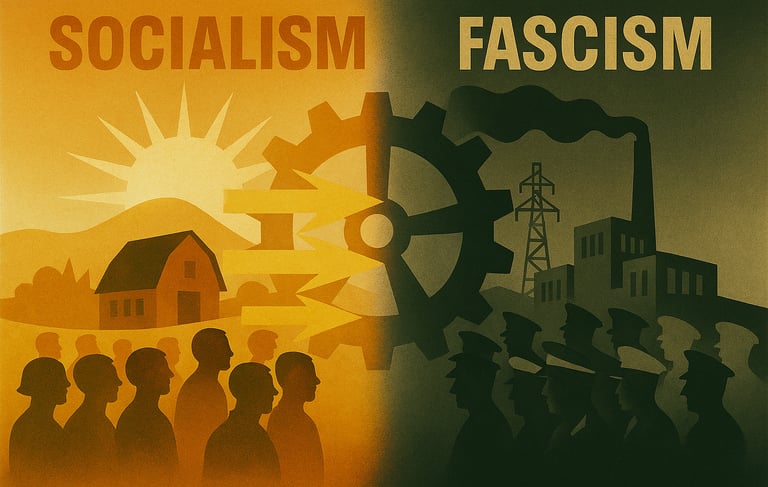
The fundamental difference between socialism and fascism lies in their treatment of society. Socialism seemingly seeks to promote equality of outcome among the collective, while fascism is about maintaining strict social hierarchies and suppressing dissent. However, both systems exhibit authoritarian tendencies, especially in their more extreme forms. For instance, certain socialist states (e.g., China, Cuba, North Vietnam) have adopted authoritarian practices in a bid to achieve their idealistic political objectives, leading to significant debates about the true nature of socialism.
Socialism and fascism can be described as two sides of the same coin. Each seeks to offer solutions to societal issues, taking separate paths to solve those issues, but quite often landing at comparable political stations. While the aim of socialism is to flatten inequalities by promising the collective an equal share, fascism often exploits societal fears and divisions to consolidate power. Understanding these nuances is crucial in a world where the lines between ideologies can and do often become blurred.
How Does Fascism Gain Traction?
Some may wonder how fascism ever gains traction among the people since it ultimately and always results in suppression and general mistreatment of the masses. After all, Mussolini was directly elected to office in 1924 and, while Hitler was not directly elected, (he was appointed Chancellor of Germany in 1933), his party won significant positions of power through elections. How, then, does a blistering tyrant persuade the people? The truth is that these men employed the socialist language of collectivism to entice the people. In his work "The Doctrine of Fascism," Mussolini wrote: "If the 19th century was the century of the individual, we are free to believe that this is the “collective” century, and therefore the century of the State."
Hitler stated this philosophy in terms more poignant. He knew that fascism, in itself, would never gain the popularity he needed. He said the following concerning the masses: ""The receptivity of the great masses is very limited, their intelligence is small, but their power of forgetting is enormous. In consequence of these facts, all effective propaganda must be limited to a very few points and must harp on these in slogans until the last member of the public understands what you want him to understand by your slogan. As soon as you sacrifice this slogan and try to be many-sided, the effect will piddle away, for the crowd can neither digest nor retain the material offered." Consequently, while Hitler was a fascist, he viewed the people through the lens of collectivism, taking advantage of the political opportunities offered by what he termed the small intelligence and enormous forgetfulness of the masses. He kept the people mesmerized and under control through exploitation of these weaknesses.
Summing It Up
Confirming the sad truth in Hitler's words, Sigmund Freud once stated that when people are treated as a collective, there is a tendency for the people to display characteristics of “weakness of intellectual ability … lack of emotional restraint … incapacity for moderation and delay, [and] the inclination to exceed every limit in the expression of emotion.” He also remarked that those in a collective (as opposed to an individual mindset) “show an unmistakable picture of a regression of mental activity to an earlier stage such as … children”
Men like Hitler and Mussolini fully understood the effectiveness of the language of socialism to gain the trust of the people (the collective) and they used that language to achieve their ultimate goal of absolute power. Consequently, it can be fairly stated that, while socialism and fascism appear to be polar opposites on the surface, both generally result in a form of totalitarian government and a society fully lacking in the equitable treatment of the citizenry. Also, they are both built upon the weaknesses and simple-mindedness of those who so willingly embrace the "warmth of collectivism" promised by those of a socialist ilk. If you are one who has become mesmerized by the seeming coziness of the collective, perhaps it is time to once again begin thinking as an individual.
See below for contact information


This book will truly enhance your understanding of the Declaration of Independence and the United States Constitution. Click the button below to check it out.
___________________________________________________________________________________________________________________________________________________________________________________________________


Contact
Questions? Reach out anytime.
Email:
contact@constitutionmatters.net
© 2025. All rights reserved.