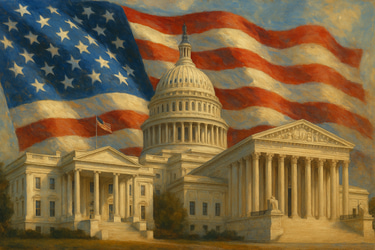
Was America Built on the Back of Slavery? Yes and No - Part 1
A look back at slavery in American history
Steven A. Carlson
7 min read
To see a list of all commentaries, click the above picture.
Proof of Citizenship and the American Voter
Is it Nationalism or Patriotism?

Can Men Get Pregnant? - Part 1
Navigating the Second Amendment
The Conflict of Ideals
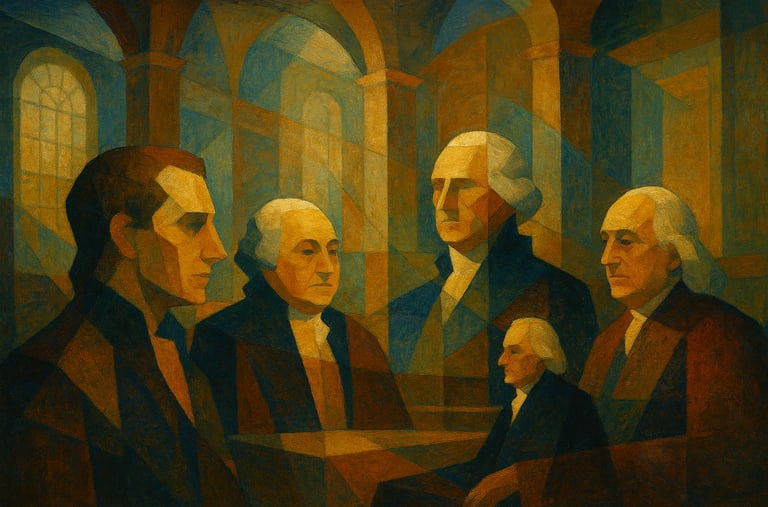
The year was 1787 and the Founding Fathers of the United States were tasked with drafting a U.S. Constitution that would serve as the cornerstone of a new nation. The mission before them was formidable for a host of reasons. The most obvious challenge could be seen in the contrasting political perspectives of the Federalists and the Anti-Federalists. Those on the Federalist side of the political aisle – men like Alexander Hamilton and John Adams – wanted a powerful federal government mirroring the strength of the English government from which they had just freed themselves. They sought a government capable of dealing with other nations from a position of strength. The autonomy of the states and the individual rights of the citizenry, while not insignificant matters, were of lower import where the Federalists were concerned.
Anti-Federalists like Thomas Jefferson and James Madison viewed the opportunity before them through a slightly different lens. To these men, personal freedoms, secured through a collection of united autonomous states that were linked together by a less than domineering federal government, was the dream for which they had fought. They believed the only means for success was to develop a nation with a government designed to serve the people, and not the other way around. (It should be noted that Adams and Jefferson were out of the country at the time of the convention, but they were strong voices when it came to elucidating their political views. At the convention, it was men like Hamilton and Madison who were some of the strongest debaters). Following are the thoughts Jefferson articulated in the Declaration of Independence:
We hold these truths to be self-evident, that all men are created equal, that they are endowed by their Creator with certain unalienable Rights, that among these are Life, Liberty and the pursuit of Happiness.--That to secure these rights, Governments are instituted among Men, deriving their just powers from the consent of the governed,
The implication from Jefferson’s words was that power not derived from the consent of the governed could not be considered just power. These differing perspectives naturally resulted in fervent debate throughout the convention as the representatives of the colonies sought to reach agreement on multiple issues – an agreement they hoped the people could accept. While the debates over the importance of various issues were undoubtedly robust, there was a single issue hiding in the shadows that many of the representatives had likely hoped to avoid – slavery.
When discussing this topic, it is important to keep in mind that, until 1776, there was no United States of America. England was in charge of the colonies and dictated the rules by which the colonists should live. Given the fact that the sale of slaves was a lucrative enterprise for England, it was not a trade the mother country would easily relinquish. Americans attempted to develop rules to slow the influx of slaves, but England would not hear of it. Consequently, before the revolution began, no one in America had the authority or wherewithal to deal with the subject of slavery. That does not make slaveholders less culpable, but the fledgling government, barely established under the Articles of Confederation and consumed by the war effort, was in no position to address the issue at that early date. Even after the signing of the Declaration of Independence, the ensuing war was first and foremost in the minds of the colonists. The notion of a united country was a secondary thought at best. In the 1770’s, the primary objective was to break away from England.
Constitutional Compromise
While there were some men like Benjamin Franklin who had earlier decried this evil component of society in this new world, most of the people who inhabited this land called America did not give the wrongs of slavery a lot of thought. That is primarily due to the fact that most had arrived from societies like England where slavery was simply an accepted way of life. That is to say, it was the norm. Until Thomas Jefferson penned the infamous words, “all men are created equal,” slavery was simply considered an economic matter. Still, for those who casually overlooked the naturally decadent character of slavery, it was an inexcusable oversight born either of ignorance or willing blindness.
As the convention continued, it was inevitable that the topic of slavery presented itself. It had been eleven years since Jefferson had declared all men as equals, and many had begun to take his words to heart. This was at least true in the northern states. However, the sentiment was not shared by those in the southern states where slavery was a way of life and, many would argue, an economic necessity. Still, attitudes toward slavery in America were beginning to tilt heavily toward the northern view.
What were the representatives to do? After all, many of the attendees, including some who were in favor of abolition were themselves, slave owners. On one hand, the Declaration of Independence articulated aspirations of individual freedom and the inherent right to self-governance. Yet, the existence of slavery actively undermined these principles for a significant portion of the population – those who were enslaved. The fact that the personal and economic interests of many Founding Fathers were inextricably linked to slavery created a dichotomy between their proclaimed values and their practices.
It was determined at the convention that acceptance of the U.S. Constitution should require ratification by no less than two-thirds of the states. Therefore, at a minimum, nine of the thirteen states must agree to accept this document as the foundation upon which the United States of America would be built. Given that threshold, it became impossible for the framers to include the abolition of slavery within that founding document. Why? It was because by attempting to abolish slavery, the representatives knew that five states – Georgia, Maryland, South Carolina, Tennessee, and Virginia – would refuse to ratify the document. In that case, there would be no Constitution and no United States of America. It is even possible that those five states might have chosen to abscond and form their own union.
Ultimately, the framers developed a compromise that they believed (hoped) might pass muster with the southern five states. The agreement was that the U.S. government would not act adversely on the subject of slavery for the first twenty years of existence as a nation. While the term slavery was omitted, Article I, Section 9, Clause 1 was clear and reads as follows:
The Migration or Importation of such Persons as any of the States now existing shall think proper to admit, shall not be prohibited by the Congress prior to the Year one thousand eight hundred and eight, but a Tax or duty may be imposed on such Importation, not exceeding ten dollars for each Person.
The framers were confident that leaving slavery untouched for that twenty-year span was the only way they could achieve the goal of ratification by any of the southern states. As an interim matter of dissuasion, however, the clause included a tax that would be levied on the import of slaves. Despite this language, convention attendees signed onto the document, including many slave owners. What this demonstrates is that the Founding Fathers had in view from the beginning that the United States of America would go down in history as the nation who, from the start, had in view the end of this ghastly mark on civilization. However, moving too quickly and too broadly would have undoubtedly torn the new nation apart to the point of extinction. It was wise, they believed, to fortify the nation and deal with the issue of slavery at a later date.
End Part 1
Birthright Citizenship - Digging into the Fourteenth Amendment

Socialism v Fascism
Reconciling Immigration and the U.S. Constitution - Part 1
Reconciling Immigration and the U.S. Constitution - Part 2
What About Greenland?
Navigating the Second Amendment
Policy v Politics
Free Speech - Rights and Responsibilities
See below for contact information
This book will truly enhance your understanding of the Declaration of Independence and the United States Constitution. Click the button below to check it out.
___________________________________________________________________________________________________________________________________________________________________________________________________


Contact
Questions? Reach out anytime.
Email:
contact@constitutionmatters.net
© 2025. All rights reserved.