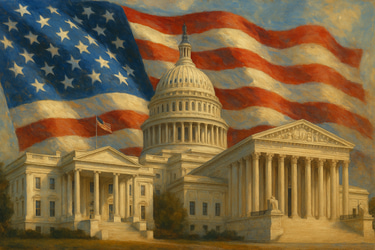
Federal Limitations and States' Rights - Part 2
A continued look into federal expansion and its impact on everyday life.
Steven A. Carlson
7 min read

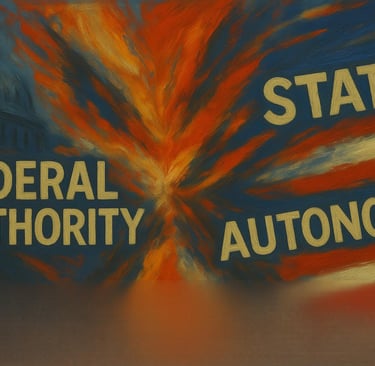
Concerning the 10th Amendment
In Part 1 of this series, we looked at the text of the 10th Amendment, which aims to limit the federal government’s reach into citizens’ lives. The wording of the amendment was fiercely debated at the time but ultimately favored fewer restrictions on federal power. Along the way, certain federal laws and court cases were reviewed, noting that some rulings seemed to push federal authority well beyond the limits set by the Constitution, even with a less restrictive 10th Amendment. In Part 2, the focus will be on one particular case that has many questioning whether the courts, especially the Supreme Court, truly understand not just the boundaries of federal power, but their own limits under the Constitution.
This more recent and well-known example of 10th Amendment challenges is the Patient Protection and Affordable Care Act (ACA), commonly known as Obamacare. The constitutionality of this law has been brought before the Supreme Court multiple times. The most significant of these cases, and the first to reach the Court, was National Federation of Independent Businesses v. Sebelius (2012). While the political debates around this case are compelling, and this statute is always viewed through a partisan lens, the focus here is to set aside opinions on the law’s merits and examine the Court’s decision purely from a constitutional standpoint.
The debate centered on whether the federal government had the power to require individuals to have healthcare and to mandate that employers offer it to their employees. Another point of contention was the law’s expansion of Medicaid, which tied a state’s federal Medicaid funding to its willingness to broaden eligibility requirements. The key question for the Court was whether Congress could impose a purchase mandate, potentially pushing its authority into the realm of “powers not delegated.”
The ACA introduced financial penalties for those without health insurance who failed to participate in the program. While the Supreme Court initially ruled that the penalties included in the statute were unconstitutional, things took an interesting twist when the Court decided the statute could stand if these payments were deemed to be taxes rather than penalties.
While the court rejected the claim that the individual mandate was within Congress’s commerce power, the mandate was found to be constitutional as a tax…Moreover, while the individual mandate is clearly intended as an incentive to purchase health insurance, many other taxes are also in place to promote certain behaviors—for example, the government taxes cigarettes to reduce nicotine consumption. Thus the Court found the mandate well within Congress’s power to tax. While Congress doesn’t have the power to require individuals to purchase health insurance, it does have the power to tax those individuals who do not.[1]
The Supreme Court employed what some have called creative reasoning to circumvent the measure’s unconstitutionality. While the mandate itself was struck down, the enforcement mechanism was upheld, effectively leaving in place a statute the Court itself viewed as unconstitutional.
The Court’s comparison of ACA penalties to other taxes is highly flawed, since those other taxes don’t require anyone to buy anything. For instance, cigarette and alcohol taxes, often called sin taxes—are meant to influence free will choices. In other words, if you don’t buy the product, you don’t pay the tax. The ACA acts in reverse in that failure to purchase results in a penalty. Yet the Court still upheld the ACA even though it admitted the statute was unconstitutional. The stronger, more constitutional response would have been for the Supreme Court to return the statute to Congress for revision so it could meet constitutional standards.
The political problem for the Court in 2012 was that the make-up of the body of Congress had changed since the statute had passed in 2010. It was clear that no reworking of the ACA would survive a congressional vote in 2012. The Supreme Court’s rather creative solution was to read into the statute something that the statute itself rejected. In this instance, a strong case can be made that the Court overstepped its own constitutional authority by essentially rewriting the law on behalf of Congress.
The decision to uphold the individual mandate partly stemmed from a highly controversial interpretation of the Commerce Clause (Article I, Section 8, Clause 3) by Judge Laurence Silberman, an Appeals Court Judge from the District of Columbia, in the 2011 case Seven-Sky v. Holder. Many legal scholars have sharply criticized this reasoning. Supreme Court Justice Brett Kavanaugh, who served on the panel for Seven-Sky v. Holder, expressed his disagreement in a dissenting opinion:
The Anti-Injunction Act, a part of the Internal Revenue Code, only bars pre-enforcement challenges to the assessment and collection of taxes. As is well known, Congress, in passing the Affordable Care Act, pointedly rejected proposals to designate the shared responsibility payment as a “tax,” instead labeling it a “penalty.” That Congress called numerous other provisions in the Act “taxes” indicates that its decision to use the word “penalty” here was deliberate. And congressional findings never suggested that Congress’s purpose was to raise revenue. The Government estimates the penalty would raise $4 billion, but congressional findings emphasize that the aim of the shared responsibility payment is to encourage everyone to purchase insurance; the goal is universal coverage, not revenues from penalties.[2]
The assenting Supreme Court Justices accepted Silberman’s progressive interpretation of the text, letting the mandate stay in place. They applied a different take on the word “penalty” even though the statute deliberately avoided/rejected that label, clearly insisting that the charge was a penalty rather than a tax. In his dissent, Justice Antonin Scalia pointed out the 10th Amendment issues this raised.
What is absolutely clear, affirmed by the text of the 1789 Constitution, by the Tenth Amendment ratified in 1791, and by innumerable cases of ours in the 220 years since, is that there are structural limits upon federal power—upon what it can prescribe with respect to private conduct, and upon what it can impose upon the sovereign States. Whatever may be the conceptual limits upon the Commerce Clause and upon the power to tax and spend, they cannot be such as will enable the Federal Government to regulate all private conduct and to compel the States to function as administrators of federal programs.[3]
It’s most interesting that the Supreme Court ruled against the statute regarding the Medicaid mandate. What makes this decision perplexing is that the reasoning used to strike it down seemed to directly conflict with the logic applied to uphold the individual mandate. The contradiction lies in the fact that the penalty in the Medicaid mandate was explicitly deemed a penalty, not a tax. Unlike the individual mandate decision, the Court concluded that the Constitution doesn’t allow penalizing states for choosing not to participate.
Striking down as unconstitutional a penalty on nonparticipating states, the court reasoned that Medicaid originally intended to cover four types of needy persons: the blind, the disabled, the elderly, and families with children. It argued that, while Congress has the right to redefine who may fall into the categories of those covered and to provide monetary incentives to states to cover certain populations of persons, the Medicaid expansion changed the original goal of the program itself—making it not just a program to cover needy persons, but a national health care plan intended to provide universal coverage that, moreover, uses penalties rather than incentives to encourage compliance. Deeming the provision too coercive, the court held instead that the government cannot penalize those states that choose not to expand Medicaid in this way.[4]
In 2017, Donald Trump took office as President after campaigning on a promise to repeal the ACA. That year, the Tax Cuts and Jobs Act brought significant changes to the Internal Revenue Code, including reducing the ACA penalty to $0. This move effectively removed the individual mandate, a major point of contention for those who saw the law as unconstitutional. Even so, the debate over whether the federal government should have the authority to oversee health care remains heated since it can be more than reasonably argued that is a power “not delegated to the United States by the Constitution.”
This case demonstrates that, much like during The New Deal in the late 1930s, the Supreme Court will sometimes set aside constitutional principles in favor of political interests. Whether a federal action is deemed constitutional often has less to do with the actual words of the Constitution and more to do with the political leanings of the majority of justices at the time. While not always the case, conservative justices tend to approach the federal government’s role based on a strict reading of the 10th Amendment, whereas liberal justices often point to the fact that the amendment doesn’t explicitly limit certain powers.
In Part 3 of this series, we will consider how to determine whether an action by the federal government should be considered within federal authority or outside the limits of authority designated by the Constitution. While the 10th Amendment is purportedly designed to restrict federal overreach, it is the Articles of the Constitution, where the specific role(s) of the government are delineated, that serve as the ultimate guide where limited government is concerned.
________________________
[1] AMA Journal of Ethics, The Constitutionality of the Affordable Care Act: https://journalofethics.ama-assn.org/ Accessed January 25, 2026
[2] Case text, Seven-Sky v. Holder, https://casetext.com, Accessed January 26, 2026
[3] Legal Information Institute, National Federation of Independent Business v. Sebelius | www.law.cornell.edu, Accessed January 26, 2026
[4] AMA Journal of Ethics, The Constitutionality of the Affordable Care Act: https://journalofethics.ama-assn.org/ Accessed January 27, 2026.
The powers not delegated to the United States by the Constitution, nor prohibited by it to the States, are reserved to the States respectively, or to the people.
See below for contact information


This book will truly enhance your understanding of the Declaration of Independence and the United States Constitution. Click the button below to check it out.
___________________________________________________________________________________________________________________________________________________________________________________________________


Contact
Questions? Reach out anytime.
Email:
contact@constitutionmatters.net
© 2025. All rights reserved.